The Advantages and Disadvantages of Four Types of Water Pumps
25+ Years of Water Pump Comparisons: What Really Works
After installing and maintaining thousands of water pump systems across North America, I've seen every type of pump in every conceivable condition. This comprehensive comparison draws from real customer experiences, performance data, and long-term reliability patterns.
Key insight from 1,000+ installations: The "best" pump type depends entirely on your specific application, backup requirements, and long-term maintenance capabilities.
Real Customer Decision Patterns
Most Common Customer Journey: Start with submersible electric pump, add hand pump backup after first power outage, later upgrade to motorized system for convenience.
Why Customers Choose Each Type:
- Submersible: High flow rate, grid-tied convenience
- Hand Pumps: Emergency backup, off-grid reliability
- Jet Pumps: Shallow wells, easy maintenance access
- Solar Pumps: Energy independence, remote locations
Customer Success Example: Maine well driller "blown away by the superiority of the Simple Pump in comparison [to Bison]... head and shoulders above [competitors] in quality"
Common Water Pumps Used In Water Wells
Based on thousands of real-world installations, here are the 4 most common types of water well pumps (submersible, lift, jet, and suction) with honest advantages and disadvantages from actual field experience.
Submersible Pumps
Submersible pumps are installed in most residential water wells in the United States and economically developed nations. The pump/motor assembly is lowered into residential water wells and pumps water through piping to the surface or just below the frost line. This water is usually routed through piping to a pressure tank for use in the home. The motor in the submersible pump is usually powered by electricity from the grid.
Advantages of Submersible Pumps
- Many different submersible pump manufacturers offer various models and sizes to fit your pumping needs.
- The motors in most submersible pump assemblies are powered by electricity from the grid.
- Some submersible pump owners have their pumps hooked up to a solar system for reliability and independence from the grid.
Disadvantages of Submersible Pumps
- Although typically reliable, submersible pump/motor assemblies result in a single point of failure. If your submersible pump assembly breaks, your family does not have their water supply.
- Submersible pumps utilize seals. These seals can become corroded over time. When the seal becomes corroded, water seeps into the submersible motor which typically shuts the motor off until the pump is repaired.
- The pump seal makes the submersible pump a bit difficult to get into for repairs.
- Submersible pumps rely on electricity. It is not uncommon for the grid to go down during major weather events and other natural disasters. When your family loses power, they also lose their water. This is the primary reason why many of our customers install a Simple Pump deep well hand pump for their well alongside their submersible pump as a backup.
Lift Pumps
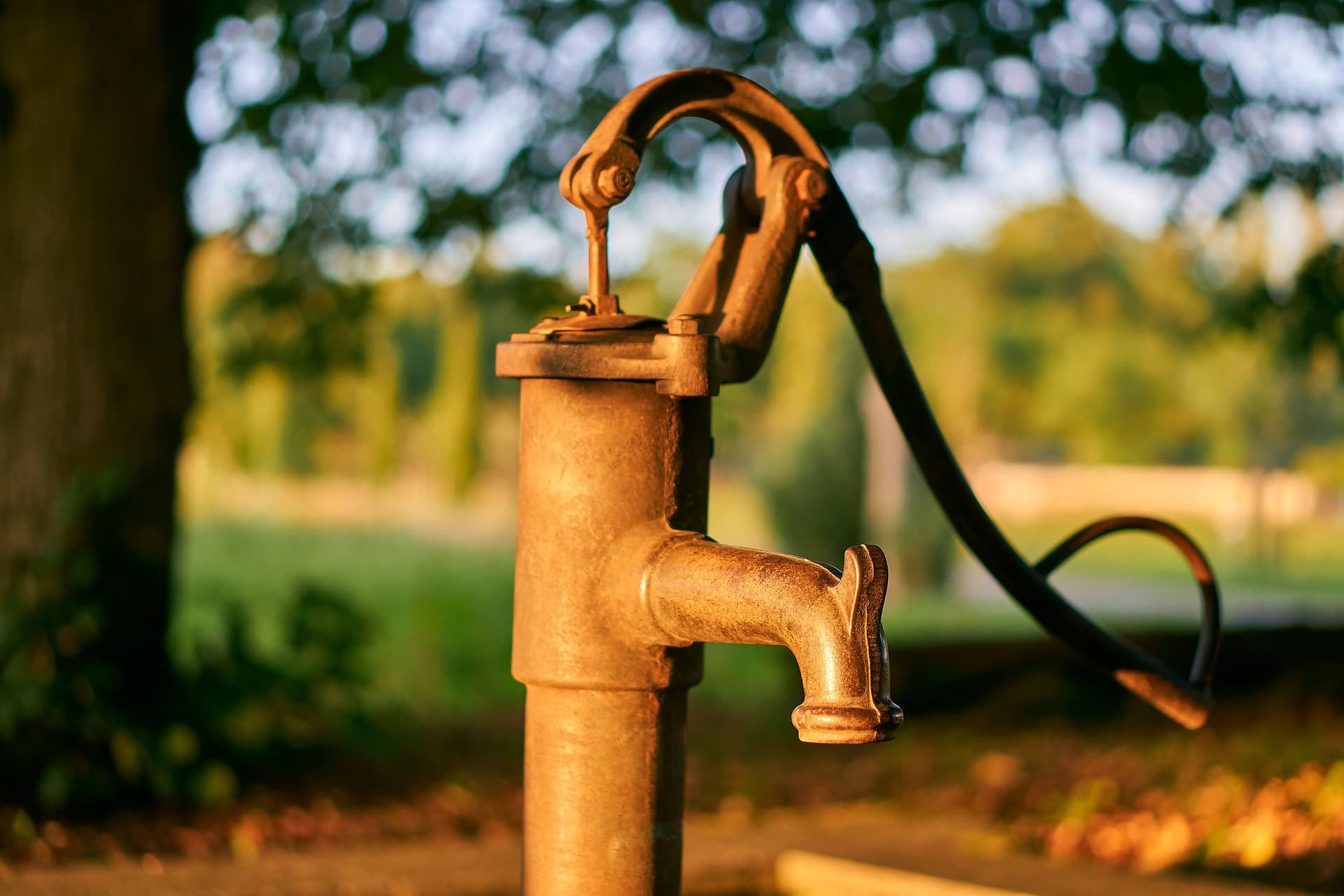
Lift pumps, also commonly called sucker-rod pumps, are usually manually operated well pumps.
These pumps work by lifting water from a cylinder located below the static water level of the well. The cylinder contains a piston and a check valve. A handle located at the surface is mechanically connected to the piston through a set of rods. As the handle is lifted up and down, the piston pumps the water through a series of pipes to the pump head at the surface.
Lift pumps are commonly used as a reliable backup to submersible pumps in many wells across the United States and other economically developed nations. This pump design is also used as a primary water source for villages in developing nations and homesteaders.
Advantages of Lift Pumps for Wells
- Lift pumps have few moving parts and are very reliable.
- Lift pumps can be installed in shallow and deep wells next to the submersible pump.
- Since the piston is located deep in the well, most lift pumps can pump water from static water levels several hundred feet below the surface.
Due to its computer machined craftsmanship and lightweight fiberglass rods, the Simple Pump deep well hand pump can pump from deeper than any other lift pump on the market – 325 feet.
- Lift pumps do not require power from the grid. Unlike submersible pumps, the hand-operated lift pump will provide water to your family when the power goes out.
- Some lift pumps can pump into your home's pressure tank.
The Simple Pump deep well hand pump is one of the few lift pumps that can pump into your home's pressure tank to give you full use of your fixtures and appliances. This gives you the confidence that your family will always have their most important resource – water.
Disadvantages of Lift Pumps
- Most lift pumps are manually operated, which requires a person to physically work to supply the water. This is ideal for emergency situations or if the water demand is low. However, this type of pump can be impractical for sustained periods of time or when the demand for water is high.
- Depending on the cylinder size and the depth of the lift pump cylinder, manual pumping can be challenging.
- Lift pumps that utilize plastic parts can only pump water from a limited static water level before the plastic breaks because of the weight of the water and the pump parts. If you are relying on a hand pump in emergency situations, you are probably better off paying a little extra for a pump with stainless steel materials instead of plastic materials.
Jet Pumps
Jet pumps utilize the venturi effect to pump water from the well.
A small centrifugal pump is located outside the well. Some of the water from the centrifugal pump is recirculated to a venturi nozzle in the pump suction line. The recirculated water flowing through the nozzle creates a vacuum in the suction line which draws the water out of the well.
Advantages of Jet Pumps
- Jet pumps are powered by electricity from the grid.
- Jet pumps are a low-priced solution for pumping water from shallow depths and are commonly used in shallow wells.
Disadvantages of Jet Pumps
- Due to their design, jet pumps are usually limited to pumping from depths no greater than 130 feet.
- The pump casing and associated piping need to be primed prior to use.
SUCTION PUMPS (FOR SHALLOW WELLS)
Similar to a jet pump, the pumping action for suction pumps takes place at the surface and not in the well.
Suction pumps usually look like hand-operated lift pumps as they have a handle that is lifted up and down to pump water. But unlike a lift pump, the piston is located just below the handle. This piston creates a vacuum that sucks water from the well to the pump head. These pumps are only used for shallow wells.
Advantages of Suction Pumps for your Well
- Suction pumps have few moving parts and some models are very reliable.
- Suction pumps are competitively priced.
- Similar to lift pumps, suction pumps do not require electricity to supply water to your home.
Disadvantages of Suction Pumps for your Well
- There is a wide variety of suction pumps on the market. The majority of the suction pumps perform poorly due to their materials and construction. Likewise, these models are not built to last more than a couple of years (sometimes less). Special care should be taken when choosing a suction pump.
- Because the suction creates a vacuum, suction pumps are limited to pumping from depths no greater than 29 feet (at sea level). Most are limited to about 20-22 feet. This maximum depth decreases even further as you go up in elevation due to decreased air pressure. As such, this pump design is only an option for very shallow wells.
Simple Pump's shallow well suction pump is designed to pump from a static water level of 25 feet or less.
Conclusion
Hopefully, this provides some useful information about the different types of pumps for your water well. The easiest pumping solutions are electric pumps that utilize motors instead of manually pumping to get your water. However, having a hand pump as a backup to your electric pump is a great option for the few times a year when you lose power due to a storm or power grid problem.
Simple Pump provides a shallow well pump and a deep well hand pump as backup options to your electric well pump. And the unique option when considering Simple Pump, is that both the suction pump and the lift pump can be configured with a motor or solar power system to make pumping your well water easier!
Choose Your Perfect System
Not sure which pump type is right for your well? Our experts can help you select the ideal solution based on your specific well depth, water needs, and backup requirements.
Use Our System Configurator - Find the right pump for your well depth and needs
Get Expert Recommendation - Professional consultation and custom system design
Ready to Get Started?
Installing a Simple Pump system is easier than you think. Request a free quote to get a custom system recommendation for your well, or contact our experts for personalized guidance.
Questions about installation? Call us at (877) 492-8711 or find a certified dealer near you for professional installation support.
Tags:
Ready to Get Started?
Get expert help choosing the right well pump system for your specific needs. Our team has 25+ years of experience in reliable water systems.