
5 Reasons the Inline Manual-Solar System Is a Better Answer Than the Alternatives
If you want automated water pumping AND a dependable manual backup from the same well, you've got a few options. For years, most of our customers who wanted both went with our LBLD motor. It worked. But it had a real catch: you could only use one pumping mode at a time.
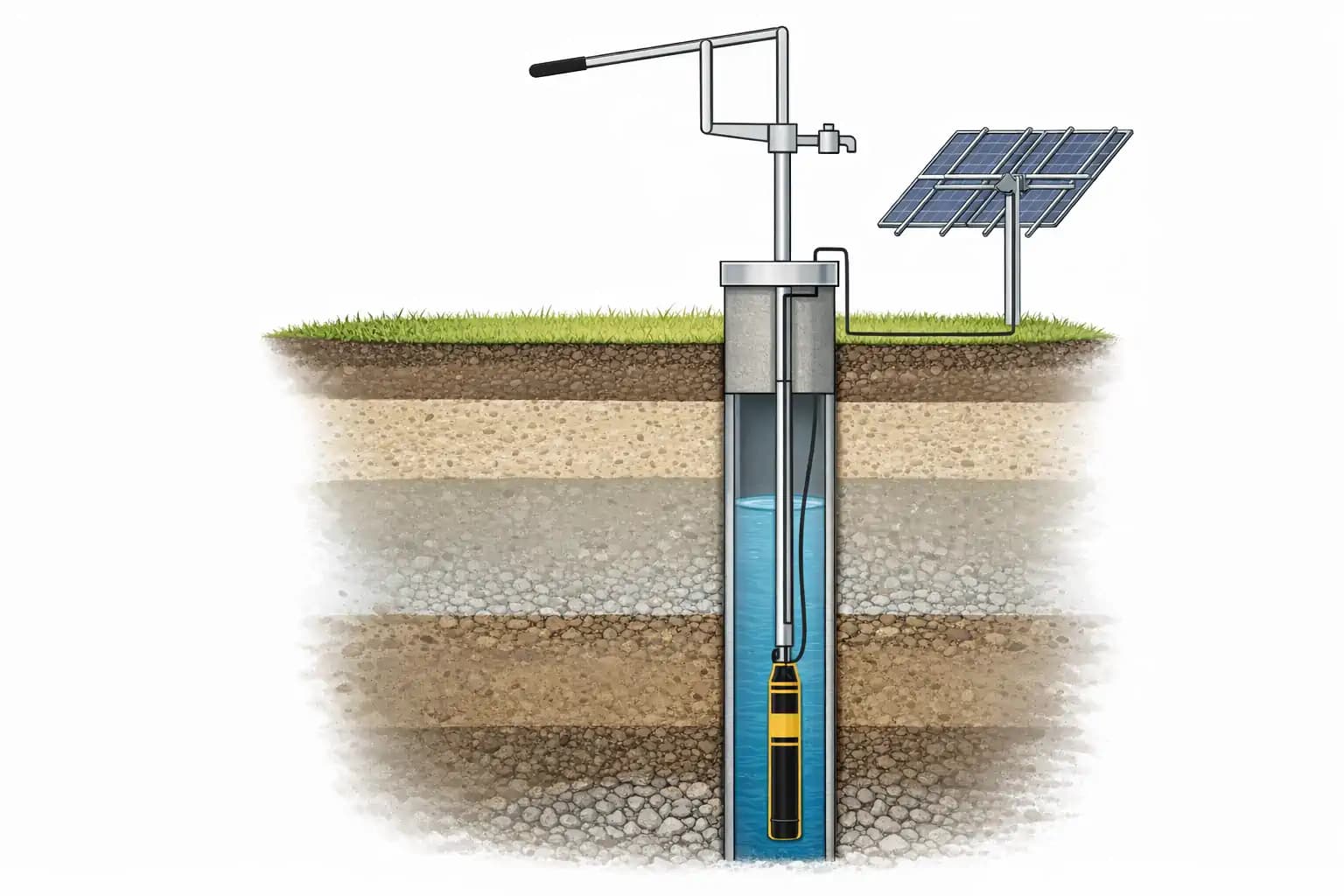
The Inline Manual-Solar Well Pump System changes that. A WORKHORSE solar submersible and the Simple Pump hand pump both run in the same well, sharing the same drop pipe, through our new Inline Dual-Pump Valve Assembly. Automated solar water whenever the sun's up. Manual hand pump any time, with no switching work on your end.
Here's where that matters compared to the alternatives.
1. Both pumping modes work at the same time
This is the big difference from the LBLD motor, and it's the reason we built the Inline Dual-Pump Valve Assembly.
The LBLD was a DC motor that replaced the Simple Pump's hand pump lever arm. It shared the drop pipes, the cylinder, and the pump head. Good design in a lot of ways. But you could only use it or the hand pump, not both. To switch from motor to manual, you had to take the LBLD off and put the handle back on. About an hour of work. In an emergency, you didn't have immediate access to your hand pump.
With the Inline Dual-Pump Valve Assembly, both are always ready. The valve responds to pressure and vacuum on its own. When the WORKHORSE solar submersible runs, pressure closes the valve. When you grab the Simple Pump lever, the vacuum opens it. No swap. No hour of work. No procedure.
That's the biggest practical improvement over the LBLD.
2. Solar-direct, battery-free automation
The LBLD was a DC motor. To run it, you needed a DC power source. Usually that meant a battery bank, which you had to keep charged through solar panels, a converter from AC power, or a generator.
The WORKHORSE Narrow Series runs solar-direct through the included PSC100 controller. No inverter. No battery bank required. When the sun's on the panels, the pump runs. When you want it to run on a schedule, you set the timer dial on the PSC100 and it runs during the daylight hours you choose.
You can add battery backup if you want it (48V recommended, customer-supplied), but you don't need it for the system to work. For off-grid homes that were fighting battery maintenance and generator fuel, that's a real simplification.
3. Your hand pump is always ready
This is the payoff of reasons 1 and 2 combined.
Your Simple Pump hand pump is sitting right there, lever arm in place, ready to pump water any time. Doesn't matter if your solar submersible is running. Doesn't matter if it's nighttime. Doesn't matter if the controller failed. Doesn't matter if your batteries (if you have any) are dead.
The hand pump is mechanical. It's independent of everything else. You grab the lever, you get water.
Compare that to:
- A grid-powered electric submersible alone. Works great when you've got power. Doesn't work at all when you don't.
- A generator-backed setup. Works until you're out of fuel.
- The old LBLD motor. Worked until you needed the hand pump and had to do the hour-long swap first.
With the Inline Manual-Solar system, automated water is there when it's convenient. Manual water is there when you need it. No transition required.
4. Retrofits any Simple Pump installation back to 1999
If you already own a Simple Pump, you don't have to replace anything to add a WORKHORSE solar submersible.
The Inline Dual-Pump Valve Assembly threads between a compatible WORKHORSE submersible and your existing Simple Pump cylinder. Your drop pipes, pump head, and pressure connections stay where they are. Your manual pumping depth doesn't change. Your hand pump performance doesn't change.
The upgrade path:
- Pull the pipe string (required any time you install a submersible)
- Thread the right valve size onto the WORKHORSE's suction port
- Thread the Simple Pump cylinder onto the top of the valve
- Reinstall
- Connect the WORKHORSE's solar cable and the PSC100 controller
The Inline Dual-Pump Valve Assembly works with every Simple Pump we've made since 1999. Every cylinder (100CA, 125CA, 200CA) with the appropriate valve size.
5. For modest water needs, you may not need a separate electric submersible
This one surprises some customers. If your household water use is modest, the WORKHORSE solar submersible paired with the Simple Pump may be all the well pumping you need. You don't have to add a separate electric submersible for grid-powered daily use.
A WORKHORSE W2H-5-200 delivers about 7 GPM at optimal solar input. The W3H-6-500 does about 10 GPM. For a lot of homes, that's plenty for daily use with a pressure tank to buffer the delivery. You get automated solar water by day, hand pump backup any time, and nothing else.
For homes with higher water demand or specific use cases (irrigation, livestock, large household), adding an electric submersible alongside the Simple Pump + WORKHORSE solar combo still makes sense. You get three pumps in one well using two drop pipes. Your electric submersible handles daily high-volume use. The WORKHORSE solar handles off-grid automated use. The Simple Pump is always-ready manual backup.
Either way, the Inline Manual-Solar system simplifies the well.
The bottom line
The alternatives all work. Some of them quite well.
- The LBLD motor (discontinued March 31, 2026) automated the Simple Pump but required a physical swap to switch between motor and manual.
- Electric submersibles give you automated water when you've got grid power.
- Generator-backed setups cover grid outages but require fuel and maintenance.
- A hand pump on its own is dependable but all-manual.
The Inline Manual-Solar Well Pump System covers the automation and the backup in one well, without the swap work, without the grid dependency, without the fuel stocking, and without dropping the manual backup. The WORKHORSE solar submersible runs during the day for your daily water. The Simple Pump hand pump is always there when you need it.
If you're thinking about this for your well, give us a call at (877) 492-8711 or request a quote. Tell us about your existing setup and your daily water needs, and we'll help you figure out what fits.
Learn more about the Inline Dual-Pump Valve Assembly | Learn more about the complete Inline Manual-Solar Well Pump System
Tags:
Ready to Get Started?
Get expert help choosing the right well pump system for your specific needs. Our team has 25+ years of experience in reliable water systems.